
BaaS: How can companies offer banking services without being a bank?
Imagine you went online to buy a pair of shoes, and at checkout, the retailer provides you with a credit line. You don’t need to use a third-party bank, this is just an easy "pay later" option. So, the store isn’t a bank, it just acts like one.
That’s Banking as a Service (BaaS) in a nutshell.
Licensed banks can now share their infrastructure with other non-banking organizations through APIs (Application Programming Interface), which allow fintechs, retailers, and start-ups to provide financial products such as accounts, cards, and loans under their own brand, with no need to deal with the banking sector’s strict compliance environment.
Defining Banking as a Service
BaaS is a model whereby licensed banks, through APIs, provide their banking infrastructure, products, and services (accounts, payments, cards, and sometimes lending) to third parties such as fintechs, retailers, or start-ups.
These entities can then offer financial services without becoming a licensed bank and offer financial products directly to their own customers under their own brand.

Note: You, as the end user, interact with the third party's product, not the bank's. The bank remains invisible.
Here’s another simple example:
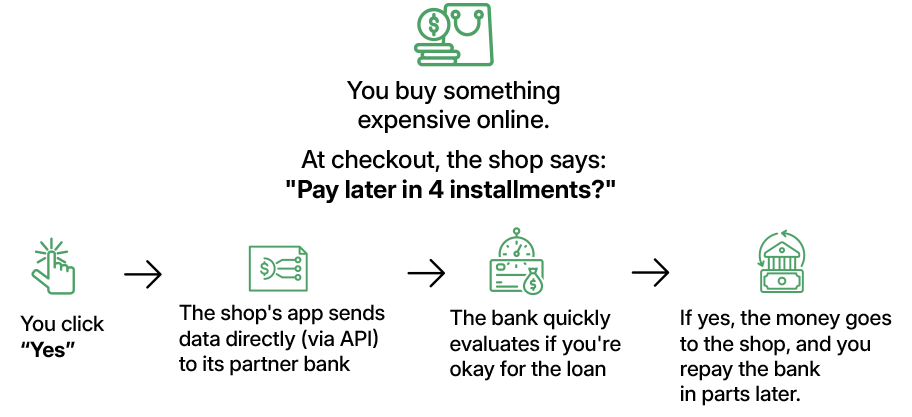
All of this is done without you leaving the shop's app.
How Does It Work?
BaaS is not one product. It is a framework that allows banking services to be broken down into modules that other companies can easily integrate into their platforms.
In most cases, there are four parties involved:
BaaS provider – a licensed institution that administers the financial services and offers them via APIs – such as a bank.
BaaS partner* – usually a fintech platform playing the role of an integration layer between the bank and the brand
BaaS user – the organization incorporating financial services into its product (shop)
End client – the clients using those services
*A BaaS partner is also known as a BaaS platform, middleware, or tech provider.

Examples of BaaS partnership models
BaaS is used within a myriad of industries that offer their banking services via a collaboration with financial institutions. Here are some examples:
Big Tech + BaaS platform
Example: Samsung + Solaris
Solaris, a German BaaS platform, partnered with Samsung and Visa to launch a virtual Visa debit card for Samsung Pay users in Germany, the first of its kind in the country.
The way it works: Solaris provides the licensed banking infrastructure, Visa supplies the card network technology, and Samsung delivers the digital wallet and customer experience.
Notably, users don't need to open a new bank account, the card can be linked to almost any existing German bank account.
Transportation firms + traditional banks
Example: Uber and the State Bank of India
Uber and the State Bank of India have teamed up to offer Uber drivers a mechanism to finance vehicle procurement.
This collaboration means that driver partners who want to work on the Uber platform are able to apply for a vehicle loan which will be approved immediately via an integrated digital offering.
E-commerce platforms + BaaS platform
Example: Shopify and Stripe
Shopify had the goal of providing financial services such as accounts and payments directly to the small businesses that sell on its platform.
To do this, it decided to team up with Stripe, a fintech company that offers payment and a banking infrastructure through APIs.
What this allows Shopify to do: Merchants benefit from the management of their store and their money in one place.
There is no need to employ traditional banks, with sellers using a Shopify dashboard to track sales, payments, payouts, and sometimes access financial tools.
BaaS market value and growth
The value of the global BaaS market in 2025 was US$22.68 billion, according to Fortune Business Insights.
Experts anticipate that growth will continue, with a value of US$26.47 billion expected in 2026, and US$108.03 in 2034 (a CAGR of 19.20% throughout the forecast period).
The number one region in the market so far is North America, which registered a 38.10% share in 2025.
For context, the BaaS market value represents less than 0.5% of the revenue produced by traditional banks around the world. Based on data from McKinsey’s Global Banking Annual Review 2025, in 2024, banks globally generated a record US$5.5 trillion in revenue after risk expenses, with the sector’s net income being US$1.2 trillion, the highest total ever documented for any industry.
BaaS vs traditional banking models
Traditional banking is generally ‘bank-centric’: customers can access products directly from the bank via bank-controlled channels (branch, online, bank app).
The BaaS approach, which is commonly summed up as "the bank goes to the customer", allows the bank to distribute its products via many channels, according to Wharton University of Pennsylvania.
BaaS, open banking, and embedded finance
Two concepts are discussed alongside BaaS:
Open banking refers to a safe financial model whereby banks use APIs to share customer-approved data with authorized third-party companies, leading to new fintech apps, more rapid payments, and better budgeting tools.
Embedded finance is a process during which financial services such as lending, payment processing, or insurance are integrated directly into non-financial apps, websites, and platforms.
What business challenges can BaaS address?
The launch of BaaS helped to solve a number of constraints for many businesses:
1. Speed-to-market
The process of obtaining a license to operate as a financial institution is rather slow and costly (capital requirements, audits, compliance teams, tech builds, and ongoing costs, all of which may require millions of dollars and a great deal of time).
Using BaaS, a company simply doesn’t require its own license, it just partners with a licensed bank (the BaaS provider) that has everything needed.

2. Distribution economics
For traditional banks, it’s becoming more costly and more difficult to acquire new clients and retain them.
But marketplaces such as Amazon and business tools like Shopify already benefit from loyal clients and numerous users, and can naturally include finance directly into the workflow (offer "buy now, pay later" at checkout, or working capital loans within an invoicing app).
Ultimately, banks gain from:
Lower customer acquisition costs (platforms already have the relationship and data)
Higher customer lifetime value (users stay longer – the app builds habit and ‘stickiness’ so once users get used to the integrated tools, they are less likely to switch)
More revenue per user (fees from finance + upsell opportunities)
3. Regulatory operating burden
As mentioned previously, managing a bank is anything but easy, and this is because banks have to continually monitor transactions, file reports to regulators, prove their systems are safe, and the list goes on.
For a merchant such as an online shop, those are very costly and time-consuming tasks. BaaS shifts most of that heavy load to the licensed bank, which already has all those systems running.
But the demand for financial products isn't limited to banks:
A retailer wishes to offer store credit
A payroll platform has the goal of enabling early wage access for employees
A travel app desires a co-branded card
The company that plugs in gets to ‘borrow’ that banking infrastructure, eliminating the need to develop everything from scratch.
Important note: The company using the banking infrastructure isn't completely free of responsibilities. It still has to make sure its own processes are clean, ensure it is not enabling fraud, and treat customers and others fairly.

Simple analogy: Imagine you’re renting a fully licensed, inspected commercial kitchen. The owner of the kitchen handles the health inspections and safety certifications, but you still can't serve poor food and blame the landlord.
Future Trends in BaaS
BaaS is maturing, which means that the technology is becoming more advanced, and the regulatory environment will be more demanding.
Trend #1. Third-party risk takes center stage
BaaS is no longer seen as new or experimental, and regulators treat it as a standard risk, with banks expected to stay in control and be responsible for what their partners do.
For example, in the United States, a bank is still responsible for carrying out its operations safely or in compliance, even if it is outsourcing this to third parties.
Thus, risk management should span the full lifecycle of a third-party relationship:
Planning
Due diligence
Contracting
Ongoing monitoring
Termination
Trend #2. Regulators are making sure users know who holds their money
There’s a global problem: people using money apps (fintech or BaaS set-ups) often don't know who really holds their money and whether it is safely protected (such as by government insurance if a bank fails), or if it is not protected at all.
Different regions handle this confusion in different ways:
In the U.S., new rules demand clearer labels and disclosures so app users aren't misled into believing that a non-bank application provides the same protection as a traditional bank would. The main question regulators want answered for consumers is therefore: "Is my money insured by the U.S. Federal Deposit Insurance Corporation (FDIC), or not?"
In the EU (most European countries):
Banking watchdogs (like the EBA) are examining apps that partner with banks since users are often confused about who's really in charge. More stringent checks and clearer rules will soon be introduced to address this.
In the UK:
Apps and websites must feature large, easy-to-see signs, badges, and messages stating exactly how much money is protected and who is providing that safety (through the FSCS scheme).
Trend #3: More action on managing risks linked with dependence on external partners
Banks are turning more digital, but relying on a few large tech firms is risky, so regulators are stepping in to increase the safety of the system.
The Basel Committee on Banking Supervision has created guidelines to assist banks in dealing with risks when they rely on outside organizations such as tech vendors.
Europe has introduced the Digital Operational Resilience Act (DORA), which basically:
Keeps an eye on large IT firms that supply banks with essential services
Defines some of these companies as "systemically important," meaning that their failure could damage the entire system
Has the goal of cutting the risk of too much dependence on a handful of providers
Trend #4: The crowded BaaS market will become smaller and more professional
Over the last 10 years, hundreds of BaaS companies have popped up, making the market cluttered and messy, with many similar platforms competing.
But things are changing. Following problems like the collapse of Synapse, weaker or less stable companies are disappearing.
What happened to Synapse Financial Technologies? A well-known BaaS middleware provider, the company collapsed in April 2024 due to serious conflicts with partner banks and the departure of major clients, which left over 100,000 users of fintech apps unable to access their funds.
In the future, there will probably be fewer but larger BaaS platforms that will:
Integrate more deeply with their clients’ systems
Feature stronger compliance
Provide more specialized solutions for particular industries such as e-commerce, and lending
Trend #5: Financial services are being built into more apps and platforms
An increasing number of financial services are being built into more apps and platforms, and many more are expected.
We are already witnessing insurance, investment accounts, and business financing tools becoming integrated into the apps that companies use on a daily basis.
For instance, Uber has added rapid payouts to the Uber Driver app, allowing drivers to view their earnings in real time, says Bain & Company.
Final word
BaaS is altering the banking world so that now, instead of visiting a bank, financial services come to you, being built into the apps and platforms you use regularly.
That's good news for innovation, for businesses, and for everyday users. However, as banking spreads across an increasing number of platforms, banking experts and regulators must solve the issue linked with responsibility – in simpler terms, to answer the question “If something goes wrong, who is responsible?”
Therefore, with the evolution of BaaS, people must remain protected.


